


A Shock to a Trusted Healthcare Team
Health New Zealand’s decision to not renew contracts with Visionwest and other not-for-profits is not simply a budget decision. It’s a decision that risks sending disruption and confusion into 1900 homes across the Waitematā area who rely on consistent, trusted care.
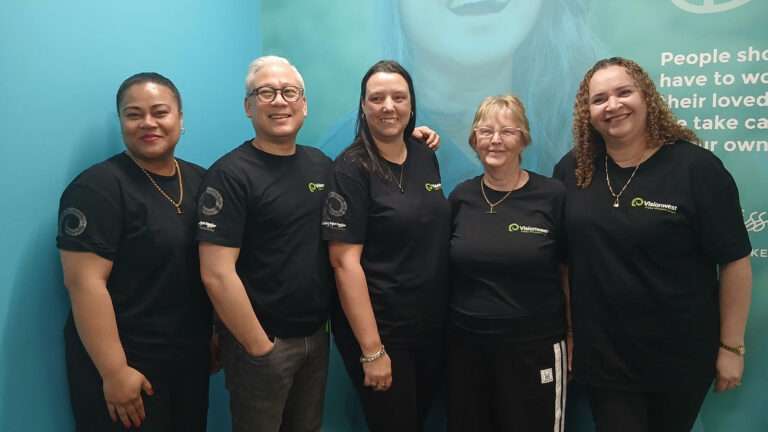
It also threatens the jobs and livelihoods of up to 650 of our healthcare team, who have been the familiar face of care and compassion in these homes. A team that carries a legacy of over 30 years of care to local communities.
The result is deeply troubling to Visionwest leadership. Tumu Whakarae (CEO) Lisa Woolley says,
“There are substantial implications for the people we serve and the dedicated staff who walk alongside them every day. At this moment, our focus is on our clients, our people, and ensuring that compassion, continuity, and care remain at the heart of what happens next.”
The Impact on Those We Serve
As a whānau focused organistion, Visionwest is most deeply concerned with the impact this decision will have on those who rely on our care.
“For many older people, a support worker is not simply someone who arrives to complete a task. They are a trusted and familiar presence who helps that person remain safe, independent and connected,” says Visionwest Director of Partnerships, Brook Turner.
“These relationships have been built over months and years. They cannot simply be transferred from one organisation to another.”
This is not like switching power companies. It’s a decision that needlessly interferes with care that has become a lifeline for whānau. A number of those affected have already written to Visionwest expressing how disheartened they are by the Government’s decision.
Corrina says the decision is
“Really disappointing to hear. We have just sorted my grandfather’s carers whom he loves, so to be told that potentially this service may discontinue next year is really heart breaking.”
Jack’s 96-year-old mother has received Visionwest home healthcare support for a number of years. He says the
“excellent early morning visits she’s been receiving” has been the reason she “still lives independently in her own flat.”
Another client similarly writes,
“The only reason I am able to live in my own home along with my husband, is because of the care I get from all the amazing ladies that help me with all the things I cannot do myself safely.”
Breaking the Ties of Wrap-Around Support
Our home healthcare service sits within a much wider community organisation that also provides social housing, homelessness support, food assistance, financial mentoring, counselling, youth support, and whānau-centred services.
Visionwest Director of Health Services Murray Penman says,
“I am disappointed that Health NZ hasn’t seen fit to recognise that the loss of the Visionwest Health NZ home care contract means it will be harder for older people to get wrap-around support.”
Across Waitematā, people will now have to “speak to many organisations rather than one organisation only.”
A Decision that Overlooks Not-for–Profits
“As a charitable trust, we have no shareholders and pay no dividends,” says Turner. “Our funding is reinvested into services, relationships and community networks that help people access the wider support they need. Community charities are not simply service providers. We are part of the social infrastructure people rely on when life becomes difficult and there is nowhere else to turn.”
Grant Taylor, Visionwest General Manager of Health and Disability says
“Diversity of choice is an important factor that should always underpin health-related decisions New Zealanders make. By removing all not-for-profit providers from home and community support services across the greater Auckland region, I believe a very important part of that choice has been removed.”
Government Must Measure What Matters
“This is an opportunity to recognise that the value of a charity cannot be measured only by the service specified in a contract,” says Turner.
“It must also be measured by what that organisation gives back, the relationships it sustains and the people it continues to support when their needs no longer fit neatly within a contract.”
We urge Health New Zealand and the Government, in the strongest possible terms, to ensure that procurement decisions properly recognise the value of continuity, community connection, charitable reinvestment, and trusted care relationships.