


Visionwest Waka Whakakitenga
Our Te Tiriti Journey
Visionwest Waka Whakakitenga began with the faithfulness of a small group of Glen Eden Baptist Church members who were moved to respond to unmet needs in their local community.
From humble beginnings in the early eighties as a drop-in ‘Friendship Centre’ at the disused Glen Eden railway station – rented for just one dollar a year – the group sought to provide tangible support for those doing it tough. In its first year, the Trust supported 100 people, and from there, it grew steadily.
More than 35 years on, Visionwest now supports over 11,000 individuals across West Auckland and Aotearoa New Zealand, with a team of more than 1,600 dedicated kaimahi (staff and volunteers) committed to seeing whānau transformation.
Visionwest Waka Whakakitenga assists whānau in times of hardship through the provision of support services that include navigational support, community housing, youth development programmes, food support, counselling, financial mentoring, community healthcare, trauma informed care, and early childhood education.
While these services are unique and distinct, Visionwest’s point of difference is our wrap-around service philosophy that sees the whole person and integrates supports that recognise the totality of their needs. Each service is delivered with a faith-led ethic and commitment to introducing and integrating Kaupapa Māori principles for the benefit of Māori and for all.
The vision of Visionwest Waka Whakakitenga is:

In all we do, we endeavour to reflect the values that we believe lead to hope and transformation for whānau.
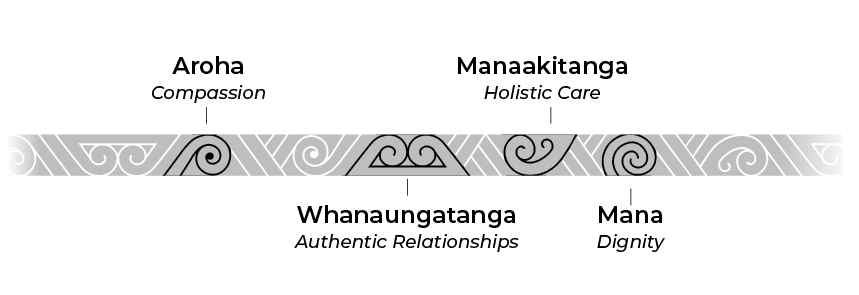
The values that underpin the way Visionwest Waka Whakakitenga deliver their services are:
A Reimagined Outlook
As part of the shift to prioritise Kaupapa Māori, work began in 2020 on establishing a new organisation identity for the Trust, that embraced the Kaupapa Māori journey and Visionwest’s commitment to Te Tiriti o Waitangi, while still recognising the value of its foundations.
Waka Whakakitenga
As part of the unfolding identity journey, the name Waka Whakakitenga was gifted to the Trust and received as Visionwest Waka Whakakitenga (previously VisionWest Community Trust). The Waka speaks of a journey together; one that acknowledges our past and looks to the future. The Whakakitenga speaks of God-given insight; the importance of a developing vision that is larger than any of us but includes all of us together.
Our journey has been guided by whakakitenga (visions) which have steered us toward a destination with tangible possibilities of transformation and healing. Based on Te Tiriti o Waitangi principles and values, we continue to journey with whānau in faith and love as we seek to support our community now, and into the future.
The Koru
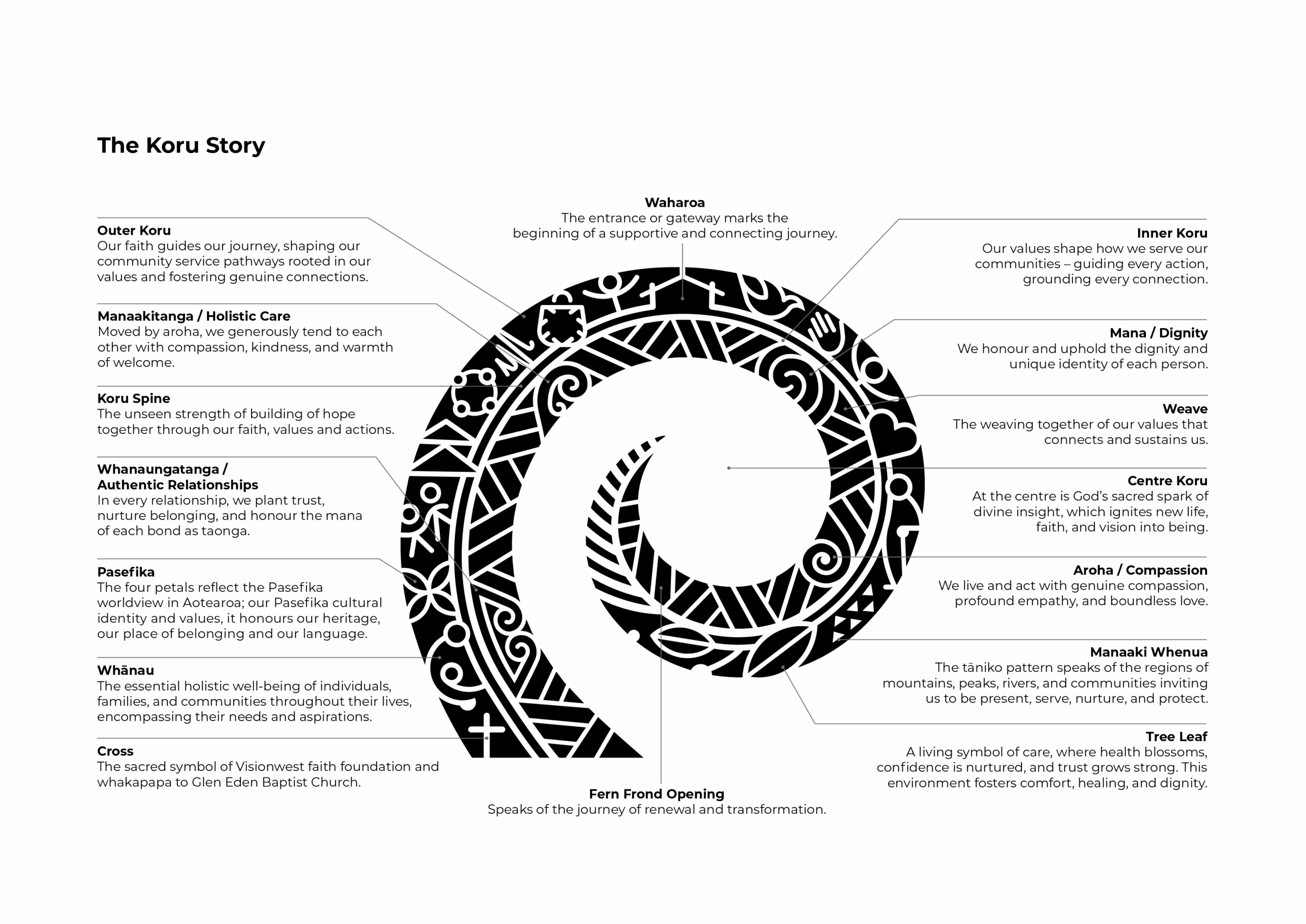
The intent of the Visionwest koru is to lead us from the past and into the future, with the koru holding our story, our vision and values, and our journey towards community transformation. The koru reminds us of our ever-present faith-led foundations, our growing Kaupapa Māori journey, and our service pathways which help to shape who we are.
The Koru Story
The koru’s inner curve contains representations of the values that form the foundation of Visionwest. The woven pattern between these symbols shows that our values are connected to form one overriding ethos that steers us as an organisation.
The outer curve of the koru contains symbols representing Visionwest community services that can support a whānau through varying stages of life. Our support is built on the foundation of our values, and the faith-led footing which is represented in a cross at the koru’s base. The cross also connects us to our roots and whakapapa at Glen Eden Baptist Church because it is here that our story begins. Symbolising the genesis or essence of the story is the centre of the koru representing God’s sacred spark of divine insight, which ignites new life, faith, and vision into being.
At the top of the koru is the waharoa (gateway) representing the starting point where a whānau begins a journey to life transformation. From here a pathway moves through the centre of the koru forming a strong spine which represents the unseen strength of building of hope together through our faith, values and actions.
A Shift in Approach
Two key concepts that have transformed Visionwest Waka Whakakitenga approach in recent years are a decision to shift from the terminology of being a faith-based organisation to a faith-led organisation. The faith-led foundation is one steeped in aroha, wairuatanga and manaakitanga. The decision to move to a description of Visionwest as faith-led, rather than faith-based, began in 2019. Equally, Visionwest has been on a journey to fully embed and embody the spirit and intent of Te Tiriti o Waitangi in our service and organisational design for more than a decade.
Prioritising Kaupapa Māori principles throughout the organisation was ratified through our landmark Treaty policy in 2021. These two shifts have significantly changed the way Visionwest Waka Whakakitenga looks and operates for optimum results in the delivery of its services to Māori and for all.
Being Faith-led
At Visionwest, being faith-led means being clothed with compassion, kindness, humility, and patience. Equally, it requires a more intentional expression of faith in the workplace, being prayerful in all our decisions and actions, and regularly seeking God’s guidance as we walk with families in need. Two scriptures that have always held us in this journey are the following:
Isaiah 58:6-9 “No, this is the kind of fasting I want: Free those who are wrongly imprisoned; lighten the burden of those who work for you. Let the oppressed go free, and remove the chains that bind people. Share your food with the hungry, and give shelter to the homeless. Give clothes to those who need them, and do not hide from relatives who need your help. Then your salvation will come like the dawn, and your wounds will quickly heal.
Your godliness will lead you forward, and the glory of the LORD will protect you from behind. Then when you call, the LORD will answer.
‘Yes, I am here,’ he will quickly reply.”
Luke 4:18-19 “The Spirit of the Lord is upon me, for he has anointed me to bring Good News to the poor. He has sent me to proclaim that captives will be released, that the blind will see, that the oppressed will be set free, and that the time of the Lord’s favour has come.”
As asserted in the scriptures above, the onus on us as a faith-led organisation, and within our capacity, is to behave in a loving and reconciliatory way, with a spirit of hope and restoration, ensuring our faith-led ethic guides every act. Doing so in the context of Aotearoa New Zealand means Visionwest treats our commitment to honour Te Tiriti o Waitangi/Treaty of Waitangi as a sacred act of service to God. Our collective aspiration is to be a Te Tiriti centred organisation in all we say and do.
Faith in context with Te Tiriti o Waitangi
Being Faith-led and operating in the context of the history of Aotearoa New Zealand, means honouring the place and role of Te Tiriti o Waitangi in our foundation and history as a nation. It is not only an important constitutional document for Aotearoa New Zealand but denotes a covenantal relationship between Pākehā and Māori. By recognising the covenantal responsibilities in Te Tiriti for all New Zealanders, a living Te Tiriti policy at Visionwest was written, strengthening our capacity to operate as a Te Tiriti-centric organisation, while aligning with our organisational and faith-led values.
Kaupapa Māori | Kia Tūmanakotia
Visionwest Waka Whakakitenga laments the breaches of Te Tiriti o Waitangi that led to Māori landlessness, poverty and misfortune. The highest statistics of poverty and homelessness (landlessness) throughout New Zealand today are Māori. Māori are overrepresented in almost every health and social service support statistic.
Compelled and moved by these troubling facts, Visionwest has been proactive in developing Kaupapa Māori practices of tikanga (ways of being), mātauranga (knowledge), Te Ao Māori values, and the principles of Te Tiriti o Waitangi, in leadership, service design and practices throughout the organisation. Overwhelmingly, the motivation is to serve every person in a way that upholds their mana and the mana of the whole whānau, especially those who uniquely identify as Māori.
To outwork our priorities that serve the interests of Māori, Visionwest has grown Māori leadership and service design capability through the growth of a leadership team, to champion Kaupapa Māori throughout the organisation. The commitment of this team is to:
- Proactively embed Kaupapa Māori development within Visionwest.
- Design and deliver several Māori-focused programmes including the Whānau Centre (wairua based, tikanga Māori led family services for all), Mātanga Oranga (Māori-informed trauma support), He Poutama Rangatahi (rangatahi development programme), and Whare Hiwa (youth housing programme).
- Influence change at governmental and other civil agency levels for housing, social supports, and healthcare.
- We believe Visionwest Waka Whakakitenga is called to partner in faith and with tāngata whenua for the work of reconciliation, acting as faithful and responsible stewards for the flourishing and protection of the land and its people to the mutual benefit of Māori and of all.
Poutama: Stepping up
Moving forward in prioritising Kaupapa Māori means taking another step to find a way to truly partner together, to co-lead and co-design the future of the organisation. The image of the Poutama steps to heaven pattern which usually symbolises genealogy and levels of learning, has been adapted to represent the Trust’s courageous steps on its Kaupapa Māori journey.
Each step is a step of whakakitenga revelation.
Te Whakakitenga Tuatahi – The first step on the Poutama is deeply connected to Glen Eden Baptist Church driven by a deep conviction and spiritual insight, to respond to local community needs in the early 1980s.
Te Whakakitenga Tuarua – The second step acknowledges a powerful series of
Te Tiriti o Waitangi wānanga (discussion forum) held for the Board of Trustees. These wānanga were facilitated by two deeply respected Māori leaders – Bradford Haami (Ngāti Awa) and Jerome Edwards (Ngāpuhi / Ngāti Rangiwewehi / Samoa) – who have walked with Visionwest from the very beginning of our Te Tiriti journey. Both Bradford and Jerome are former Visionwest Board members and continue to guide us in our journey. These moments led Lisa Woolley – CEO, to seek funding for the development of a Kaupapa Māori-centred model of care, as expressed in the Matapuna Whānau Centre (commissioned in 2015). The Whānau Centre model enables whānau Māori to connect with our services through their whakapapa.
Te Whakakitenga Tuatoru – The third step on the Poutama, involved establishing Māori representation at all levels across the organisation. This was signified by the appointment of Māori to the Board, Māori to Senior Leadership, Fred Astle to the Executive team as Head of Māori Service Development, and the adoption of our new Visionwest Te Tiriti o Waitangi Policy.
Te Whakakitenga Tuawhā – The fourth and latest step of the Poutama for Visionwest Waka Whakakitenga is the exploration of partnership, co-design and co-creation, eventually embodied in the establishment of shared leadership for the organisation.
These steps demonstrate our commitment to understanding and living out the principles of partnership, participation, protection, and equity, so that the spirit of Te Tiriti o Waitangi is honoured and embedded across the entire organisation. The work led to the development of our He Pou Whakakitenga Kaupapa Māori Framework and its four pou (pillars) of wairua, hauora, mātauranga and tikanga providing a more comprehensive guide to Whānau Services and Kaupapa Māori development throughout our organisation.

Shared Leadership. The Journey begins
Over 2022-2024 Visionwest Waka Whakakitenga Leadership began a series of kōrero (discussions) and wānanga focused on exploring what a shared leadership model for the organisation could look like and how it could be implemented in the leadership structure.
In March of 2024, a wānanga (discussion forum) was held at Te Mahurehure Marae in Point Chevalier with the Trustees, Executive team and Glen Eden Baptist Church Elders in attendance. Facilitated by The Right Reverend Te Kitohi Pikaahu ONZM and esteemed Māori leader, Bradford Haami, the wānanga helped participants understand God’s intention for Te Tiriti o Waitangi, what it meant at the time of signing of Te Tiriti, and what the outworking of the principles of Te Tiriti o Waitangi could look like today within the context of Visionwest Waka Whakakitenga.
The wananga and subsequent kōrero led to the Board approving a shared leadership model at their Strategic Planning Retreat on 3 – 4 May 2024. As a result of this decision, Fred Astle (Tainui) was appointed into the position of Tumu, Deputy Chief Executive commencing on the 12 August 2024, to share leadership with the Tumu Whakarae, CEO, Lisa Woolley.
Shared leadership as the model of leading at the executive level was a courageous step that is considered both innovative and honouring to Te Tiriti o Waitangi, by putting into action a true partnership between Māori and Pākehā.
Shared Leadership Framework
Our Shared Leadership approach is grounded in our Visionwest Kaupapa Māori Framework He Pou Whakakitenga and carries a distinct visual identity of the Tauihu to express our vision to all who seek support from Visionwest, and those who wish to join us, as kaimahi. It reflects the wairua of our beginnings – being faith-led, deeply relational, and committed to collective learning through wānanga. This foundation continues to guide our journey, shaping how we take each next step together which is our tikanga toward fulfilling our shared vision and mission.


He Pou Whakakitenga
Kaupapa Māori Framework
Guided by our values, spiritual identity, and unwavering commitment to embody the principles of Te Tiriti o Waitangi, our He Pou Whakakitenga Kaupapa Māori Framework (Visionwest Māori Pillars) aims to foster greater cultural understanding and partnership with individuals and communities as we explore new possibilities together. Like the posts that hold up the walls and ridgepole of the wharenui (meeting house), our framework supports the vision and values of Visionwest Waka Whakakitenga. Our goal is to emulate the whānau-centric philosophy of the marae, fostering a culturally vibrant environment steeped in tikanga and led by Māori, with Māori and non-Māori supporting whānau together to see entire communities flourish.
The Imagery Adopted to Represent The Waka Whakakitenga
The imagery adopted to represent the Waka Whakakitenga led by Shared Leadership is threefold, a double hulled waka, a whare and a tauihu (prow of a waka).

Te Waka Hourua: The Double-Hulled Waka
Our Shared Leadership journey is expressed through the double-hulled waka – a powerful metaphor that embodies the spirit and direction of Visionwest. One hull represents Te Wairua o Te Tiriti o Waitangi –the spirit of partnership and covenant. The other is Visionwest Waka Whakakitenga – our visionary response to God’s call in serving our communities. Bound together, these hulls symbolise our enduring commitment to the Te Tiriti relationship and provide the stability and propulsion to journey toward aroha and healing through authentic partnership.
Connecting these two hulls is the papa noho – the sacred platform that represents te ao wairua, our spiritual foundation. It is here that we stand together in shared kaupapa, embracing our faith-led identity and living out our values of aroha, compassion, kindness, manaakitanga, and whanaungatanga. This space reminds us of our beginnings in Glen Eden Baptist Church, where Visionwest was birthed, and affirms our ongoing commitment to be faith-led, not merely faith-based, as we navigate our future.
We affirm that a Kaupapa Māori approach is integral to every part of our journey. It shapes our values, practices, and strategic priorities, and grounds us in the pursuit of whānau wellbeing, transformation, and equitable outcomes for Māori and for all. Rooted in biblical principles that align with the covenantal intent of Te Tiriti o Waitangi, our waka is guided by shared wairua, collective wisdom, and a deep commitment to honouring every person’s mana.

Te Wharenui: The Meeting House
The Wharenui is symbolised by the descending Maihi, the outstretched arms of the house at the marae, embracing all who gather within its protection. It is a place of safety, connection, and belonging, grounded in Māori values. The Pākati haehae pattern within the wharenui reflects not only the strength and resilience of the structure but also the mana and identity of the people it shelters.
Just as the Maihi extends outward in welcome, the Pākati haehae represents the whānau as guardians, upholding whakapapa (genealogy), tikanga (customs), mātauranga (knowledge), and wawata (aspirations), fortified by a shared purpose. Our vision for our staff and community whānau is to create a space that is welcoming and safe, where everyone feels a deep sense of belonging, surrounded by aroha and mutual respect.

Te Tauihu: Prow Of A Waka
The Tauihu, the ornately carved prow of a waka, is a powerful and enduring symbol of Māori leadership. It is not merely an adornment affixed to the front of a canoe; it is the guiding force that leads the waka through both calm and turbulent waters.
Traditionally, the tauihu bears the carved mask of a spiritual figure or ancestor – embodying protection, foresight, and divine presence – ensuring that the people aboard reach their intended destination. The word ihu refers not only to the nose, but also carries connotations of a leader who journeys ahead, navigating the unseen and bearing the first winds of challenge opportunity. In this way, the Tauihu becomes a living metaphor for leadership – spiritual, relational, and strategic. It represents the one who sees what others cannot yet see, the one who carries the weight of direction, guardianship, and responsibility.
Leadership, like the tauihu, does not exist in isolation but is deeply anchored in whakawhaungatanga or relationship – between leader and people, leader and environment, and leader and the divine. Māori leadership is inherently relational, grounded in ancestral mātauranga knowledge and wisdom and a collective ethic of care or tikanga. It is not simply about command; it is about wayfinding – navigating complexity with vision, humility, and courage.
At Visionwest, the Tauihu stands as a profound symbol of Shared Leadership, embodying the partnership between the Tumu Whakarae and Tumu who journey together at the helm of Visionwest Waka Whakakitenga. Just as the Tauihu leads but remains part of the waka, our leadership is embedded in collective purpose and service. Anchored in He Oranga Tāngata, He Oranga Hapori – transformed lives and healthy communities – and guided by the principles of Te Tiriti o Waitangi, this model is sustained through the values of aroha, whanaungatanga, manaakitanga and mana. It ensures that both whānau and one another are held with strength and deep care.
At the apex of the Tauihu, the carved ancestral figure symbolises our te ao wairua traditions in being faith-led in Te Wairua Tapu-the Holy Spirit-the ultimate navigation towards a just governance and righteous leadership. This spiritual guidance reminds us that leadership is not only strategic, but sacred. It aligns us to our sacred purpose, grounding our decisions and direction in wairua and whakapono as the kaitiaki guardianship of our Visionwest whakapapa.
As a faith-led organisation, our journey toward holistic hauora outcomes for Māori, and for all, comes into clearer focus as we embrace kaupapa Māori in our practice and systems. Under the guidance of expert Māori leaders and trusted Māori partners, the new Tauihu o te Waka Whakakitenga is weaving kaupapa Māori principles into every fibre of Visionwest’s operations. This will not only strengthen our services, but also enrich the very culture of our organisation with authenticity, integrity, and mana.
Closing Statement
Over the past 15 years, Visionwest Waka Whakakitenga has embarked on a transformative journey, guided by the spirit of being faith-led and the embodiment of Te Tiriti o Waitangi, which forms the foundation of our Te Tiriti journey and new shared leadership model. This journey has been marked by courage, openness, resilience, innovation, and a steadfast commitment to the values of aroha, whanaungatanga, manaakitanga and mana. Through the integration of Kaupapa Māori principles and our dedication to holistic care, Visionwest has created a legacy of hope and dignity for all whānau.
As we look to the future, our aspirations are rooted in these foundational values. We envision a community where every individual is valued, supported and flourishing, where shared leadership through aroha, fosters collaboration and empowerment, and where the fullness of our faith-led Te Tiriti o Waitangi journey guides us towards equity, justice and healing.
Our unwavering commitment to transforming lives and healthy communities drives us forward with courage, confidence, humility, and a shared vision for a future filled with hope and opportunity. “He ringa tōhau, he manawa aroha – ka wātea te here, ka marama te ara.” A hand extended, a heart of compassion – the chains fall away, and the path becomes clear.
Appendices: Te Tiriti o Waitangi Policy He Pou Whakakitenga